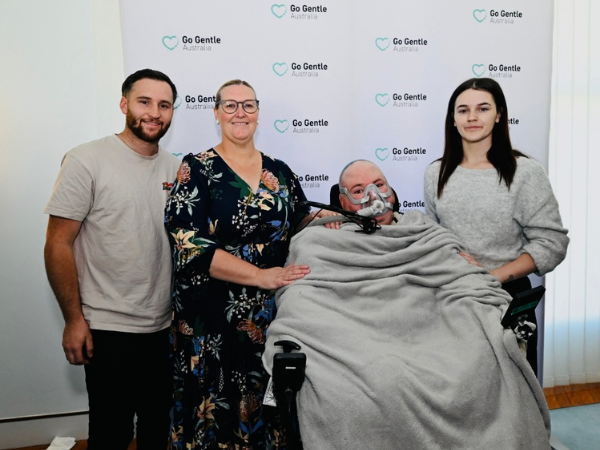
When voluntary assisted dying (VAD) became available in the ACT on 3 November last year, Jason Smith was among the first to apply.
Living with Motor Neurone Disease (MND), Jason accessed VAD less than eight months later, surrounded by his wife, Anthea, children Brae and Georgia, and the carers who had supported him throughout his illness.
Diagnosed at just 39, Jason spent years advocating and fundraising for MND research alongside Anthea. The couple also became passionate supporters of VAD reform, sharing their experiences publicly and speaking at the launch of Go Gentle Australia’s State of VAD report in Canberra.
Before VAD became legal in the ACT, they had even considered moving interstate to ensure Jason could access the option. When eligibility opened, they wasted no time in applying.
Anthea said VAD had given Jason something increasingly rare as his disease progressed: control over his own future and a sense of relief.
In the final stages of his illness, Jason depended on a ventilator around the clock and used a cough assist machine to help clear his airways. He used a wheelchair, his eyesight had worsened and speaking had become difficult. The option of VAD eased his fears that he would die by choking or drowning in his own mucus.
Anthea believes decisions about VAD should rest with the person facing the illness.
“I want people to know it’s the individual’s choice,” she said. “I don’t think anyone else has the right to make that decision for them. People deserve the opportunity to die with dignity.”
Go Gentle’s 2026 State of VAD report reveals that one in three MND deaths in Australia are now via VAD. Speaking at report launch, Anthea reminded attendees that real families are at the centre of end-of-life laws. High school sweethearts from Nyngan in central New South Wales, Jason and Anthea moved to Canberra for Jason’s career as an electrician and later a project manager. Together they raised two children, Brae and Georgia.
“Behind every policy, every report and every decision, there are people and families,” she said. “It’s not about how to die, but how to live the very best you can until the end.”
It is for people like Jason and Anthea that Go Gentle continues to advocate, ensuring they have compassionate end-of-life choice, and that Australians facing terminal illness have the option to decide how their final chapter unfolds.